
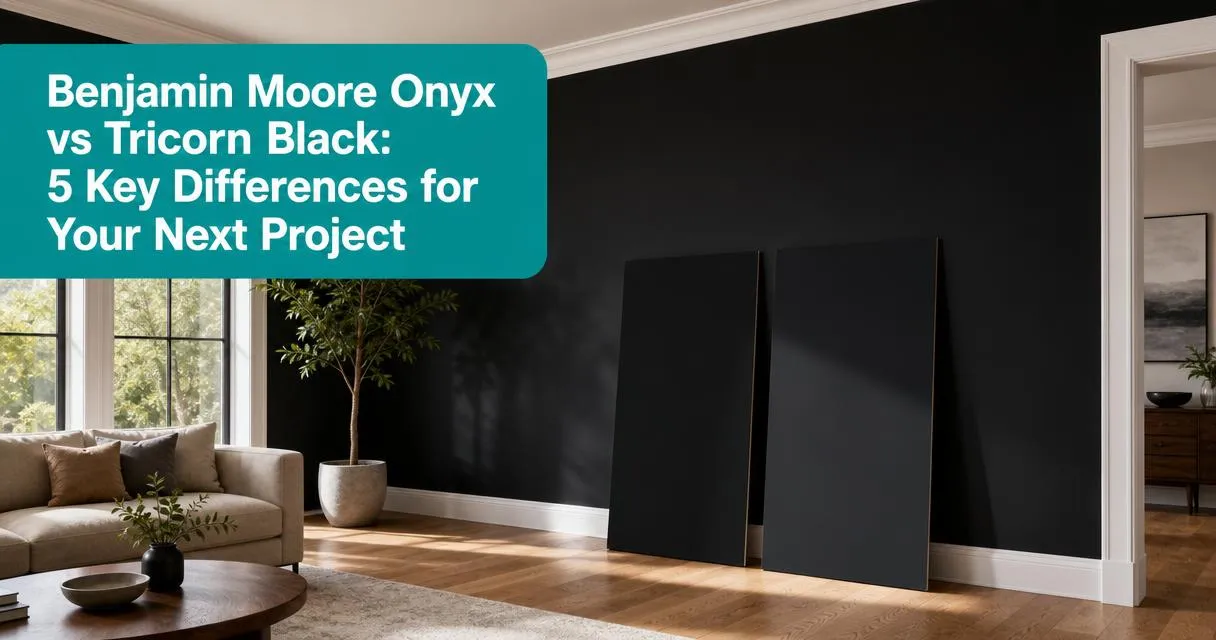
Choosing between Benjamin Moore Onyx and Sherwin Williams Tricorn Black isn’t about picking a winner. It’s about matching the right near-black to your lighting, surfaces, and design direction.
Onyx leans slightly warmer with subtle versatility. Tricorn Black delivers the truest neutral black with minimal undertone shift. Both excel on cabinets, doors, accent walls, and exteriors, but the coordinating colors and room conditions that suit each are notably different.
Key Takeaways
- Benjamin Moore Onyx (2133-10) reads as a slightly softer black with barely-there warmth that pairs naturally with wood tones and warm whites
- Tricorn Black (SW 6258) is considered one of the truest neutral blacks available, with minimal undertones and a cooler feel that works best in modern palettes
- The LRV difference is small on paper but becomes visible in north-facing rooms or low-light conditions where Onyx appears slightly lighter
- Both work on kitchen cabinets, front doors, accent walls, and exteriors, but your pairing strategy will differ based on which black you choose
- Onyx can read slightly brown in warm afternoon light, while Tricorn Black can feel stark in traditional spaces with warm wood tones
- Always test both colors with peel-and-stick swatches in your actual room lighting before committing to a full gallon
Benjamin Moore Onyx Vs Tricorn Black Compared
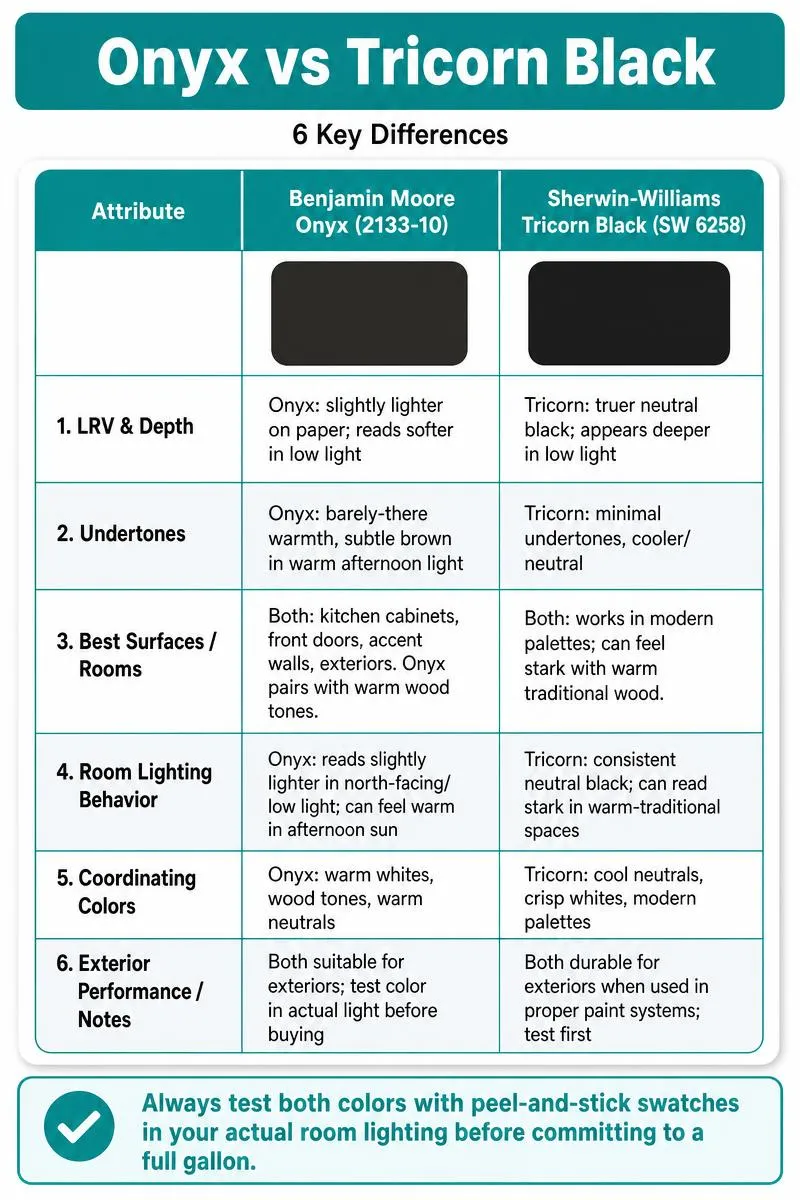
| Attribute | Benjamin Moore Onyx (2133-10) | Sherwin-Williams Tricorn Black (SW 6258) |
|---|---|---|
| LRV & Depth | Slightly lighter on paper; reads softer in low light | Truer neutral black; appears deeper in low light |
| Undertones | Barely-there warmth; can read subtly brown in afternoon sun | Minimal undertones; cool/neutral |
| Best Surfaces / Rooms | Kitchens, doors, accents, exteriors; pairs with warm wood tones | Kitchens, doors, accents, exteriors; suits modern palettes |
| Room Lighting Behavior | Reads lighter in north/low light; warms in afternoon sun | Consistent neutral; can read stark in warm-traditional spaces |
| Coordinating Colors | Warm whites, wood tones, warm neutrals | Cool neutrals, crisp whites, modern accents |
| Exterior Performance / Notes | Suitable for exteriors; test color in actual light | Durable with proper paint systems; test first |
What Is Benjamin Moore Onyx?
Benjamin Moore Onyx (2133-10) is a dark black with a barely-there warm undertone that keeps it from feeling harsh or industrial. The warmth is subtle enough that most people read it as a true black at first glance. Side-by-side with cooler blacks, you’ll notice it has slightly more depth and softness.
Onyx performs exceptionally well on several surfaces:
- Kitchen cabinets paired with warm countertops like butcher block or warm-toned quartz
- Accent walls in rooms with wood flooring
- Painted banisters and front doors on homes with warm brick or neutral siding
It creates contrast without the stark modern edge that cooler blacks deliver.
The color pairs naturally with warm whites like Benjamin Moore White Dove or Simply White, natural wood tones, and soft grays in the greige family. This makes it easier to integrate into traditional, transitional, or farmhouse-style interiors where you want drama without sacrificing warmth.
The main weakness shows up in rooms with strong warm afternoon light. In these conditions, Onyx can read slightly brown or charcoal rather than true black. This is especially noticeable on large surfaces like full accent walls or exterior siding.
Related Reading
A practical guide comparing drywall sealers and primers to help you prep surfaces and choose the right undercoat before…
What Is Sherwin Williams Tricorn Black?
Sherwin Williams Tricorn Black (SW 6258) is widely recognized as one of the truest neutral blacks in any paint brand’s lineup. It has virtually no discernible undertone. This means it holds color consistently across different lighting conditions without shifting toward brown, blue, or green.
Tricorn Black excels in several applications:
- Modern interiors with clean lines
- Contemporary exteriors
- Trim and door applications where you want maximum contrast
- Spaces paired with cool whites or stark gray palettes
It delivers the crispest, most defined black available without veering into specialty or designer blacks.
It pairs best with cool whites like Sherwin Williams Pure White or Extra White, cool grays, and minimalist color schemes. The lack of warmth makes it ideal for spaces where you want a neutral anchor that won’t compete with surrounding colors.
The tradeoff is that Tricorn Black can feel cold or stark in traditional spaces with warm wood tones, brass fixtures, or cream-colored walls. In these settings, it creates contrast but can look out of place or too severe for the overall design direction.
Head-to-Head: LRV and Depth
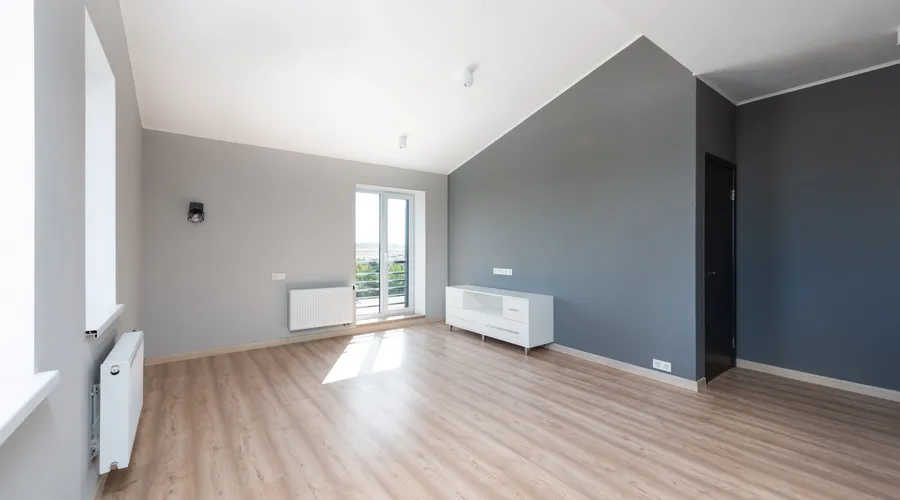
Both Onyx and Tricorn Black sit at very low LRV (Light Reflectance Value) levels, meaning they absorb most incoming light rather than reflecting it. Onyx has an LRV around 3.5 to 4, while Tricorn Black sits closer to 3. That difference is small on paper but becomes visible when you view large samples side-by-side.
Onyx appears slightly lighter, not because it’s gray or diluted, but because its subtle warmth reflects marginally more light than Tricorn’s pure neutral base. You won’t notice this seeing only one color at a time. But comparing swatches on adjacent walls reveals Onyx as fractionally less intense.
In practical terms:
- Onyx works better in already-dark rooms where you want depth without caving the space
- Tricorn Black holds its intensity even in brighter spaces where you need the black to stay strong
Head-to-Head: Undertones
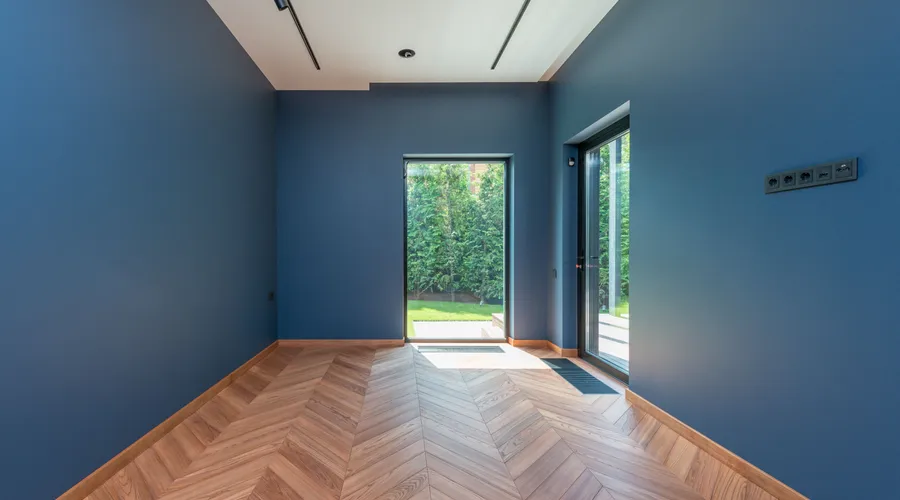
Onyx carries a subtle warm or neutral lean that becomes visible in certain lighting conditions, particularly warm afternoon sun or warm LED bulbs. The undertone isn’t obvious enough to call it a “warm black.” But it’s present enough to soften the overall color and make it feel less stark.
Tricorn Black has no discernible undertone in most lighting conditions. It doesn’t shift toward blue in cool light or brown in warm light. This is rare for blacks and part of why designers favor it for projects where color consistency across rooms or exterior surfaces matters.
Throughout the day, each color behaves differently:
- Onyx shifts slightly, becoming softer and warmer in golden-hour light and more neutral in midday or overcast conditions
- Tricorn Black stays remarkably consistent, reading as the same true black from morning through evening
Related Reading
Tips on high-hide paints and techniques for masking stains and odor — useful if you’re choosing a dark black and need…
Head-to-Head: Best Surfaces and Rooms
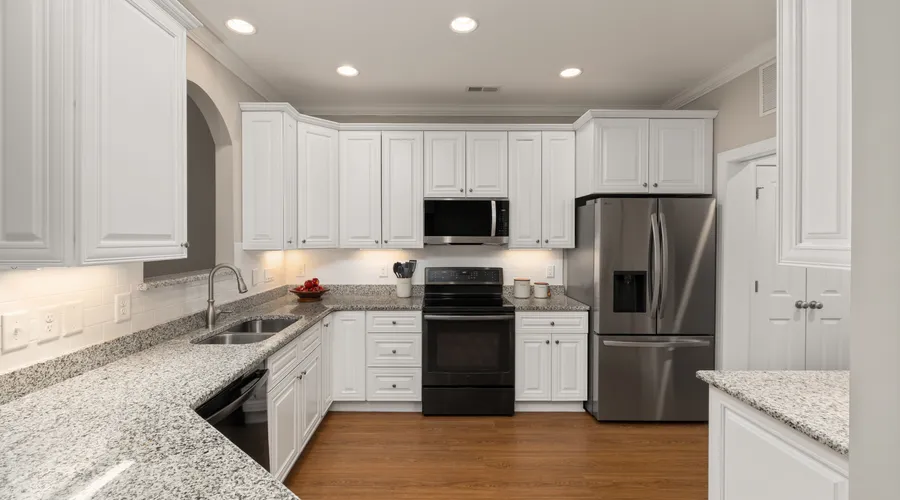
For kitchen cabinets:
- Onyx works better when pairing black cabinets with warm countertops like butcher block, warm-toned quartz, or natural wood islands
- Tricorn Black is the stronger choice for modern kitchens with white quartz, stainless appliances, and cool-toned backsplash where you want maximum contrast and crisp definition
For exteriors and trim:
- Tricorn Black holds its cooler tone against vinyl siding, fiber cement, or cool-painted brick, staying neutral without picking up warmth from surrounding surfaces
- Onyx reads softer on traditional siding like wood clapboard or warm stucco, blending rather than hard contrast
For accent walls and interior doors, both are viable. The decision comes down to your pairing colors:
- Warm whites, wood furniture, or brass fixtures? Onyx integrates more naturally
- Cool grays, chrome hardware, or stark white trim? Tricorn Black delivers cleaner definition
Head-to-Head: Coordinating Colors
Onyx pairs most successfully with several colors:
- Benjamin Moore White Dove (OC-17) for softer, warmer contrast
- Simply White (OC-117) in spaces with natural wood accents or warm flooring
- Soft grays in the greige family like Revere Pewter or Balboa Mist
The color holds up beautifully against medium-toned wood stains.
Tricorn Black works best with:
- Sherwin Williams Pure White (7005) or Extra White (7006) for maximum contrast and crisp lines
- Cool grays like Repose Gray or Agreeable Gray, where Tricorn’s coolness balances Agreeable’s slight warmth
Avoid pairing Tricorn Black with cream or warm off-whites, as the contrast will look off-balance.
For exterior trim or shutters:
- Onyx coordinates with warm siding colors like beige, tan, or warm gray
- Tricorn Black looks sharper against cool gray, white, or blue-toned siding
Head-to-Head: Exterior Performance
Both colors absorb significant heat on exterior surfaces. This is a consideration if you’re painting siding, shutters, or doors in full sun. Use a satin or semi-gloss sheen on exterior applications to improve durability and cleaning. Expect faster fading on south-facing surfaces compared to lighter colors.
On exterior surfaces, each color behaves differently:
- Tricorn Black holds its color better on brick and stucco because the cooler undertone doesn’t clash with natural warmth in those materials
- Onyx can look slightly muddy on warm brick but reads beautifully on wood siding or fiber cement in neutral tones
Apply both paints in at least two coats for full coverage and fade resistance. Use a high-quality exterior formula to minimize chalking and color shift.
For Onyx, Benjamin Moore Aura or Regal Select are recommended. For Tricorn Black, Sherwin Williams Emerald or Duration work well.
Which Should You Choose?
- Warm, traditional kitchen cabinets: Choose Onyx if your kitchen has butcher block countertops, warm wood floors, or cream subway tile. The subtle warmth keeps the space from feeling cold.
- Modern minimalist accent wall: Choose Tricorn Black if your room has cool gray walls, white trim, and contemporary furniture. The true neutral black creates the cleanest defined focal wall.
- Exterior front door with warm brick: Choose Onyx to complement the brick warmth without creating jarring contrast. Pair it with warm white or cream trim for a cohesive look.
- Exterior trim with cool-toned siding: Choose Tricorn Black for sharp definition against gray, blue, or white siding. It holds color better and creates crisp lines modern exteriors need.
- Full dark room like an office or den: This depends on your lighting direction. If the room gets warm afternoon light, Tricorn Black will hold its true black better. If the room is naturally cool or north-facing, Onyx will feel slightly softer and less cave-like.
FAQs
1. Is Benjamin Moore Onyx a true black?
Onyx is very close to a true black but carries a barely-there warm undertone that becomes visible in certain lighting conditions or when compared side-by-side with cooler blacks. Most people read it as true black in everyday use.
2. What is the Benjamin Moore equivalent to Tricorn Black?
Benjamin Moore Black (2132-10) is the closest equivalent to Tricorn Black in terms of being a true neutral black with minimal undertones. Onyx is slightly warmer and softer by comparison.
3. Is Onyx darker than Tricorn Black?
No, Tricorn Black is slightly darker with an LRV around 3 compared to Onyx’s LRV of 3.5 to 4. The difference is subtle but visible in side-by-side comparisons, especially in low-light rooms.
4. What is Benjamin Moore’s most popular black?
Benjamin Moore Black (2132-10) is the most popular true black, followed by Onyx for those wanting a slightly softer, more versatile option. Jet Black (2120-10) is also widely used for high-contrast modern interiors.
5. Can I match Onyx in Sherwin Williams color system?
Yes, most paint stores can color-match Benjamin Moore Onyx into Sherwin Williams paint, though slight variations in base formulas may cause minor differences. Test a small batch before committing to large quantities.
6. Which black is better for a front door: Onyx or Tricorn Black?
Onyx works better on homes with warm brick, wood siding, or neutral exteriors, while Tricorn Black looks sharper on homes with cool-toned siding or modern architecture. Match the black to your home’s existing warmth or coolness for the most cohesive result.
Final Verdict
Choose Onyx if you want a versatile black that integrates with warm whites, wood tones, and traditional or transitional interiors. It delivers drama without the stark edge that cooler blacks bring, making it easier to work with in spaces where warmth matters.
Choose Tricorn Black if you need the truest neutral black available, especially in modern spaces with cool palettes, crisp whites, and clean lines. It holds color across lighting conditions and creates the sharpest contrast for contemporary design.
Order peel-and-stick samples of both colors and test them on your actual surface in your actual lighting for at least 24 hours before making a final decision.
If you’re in the Fish Hawk metro area and want help choosing or applying a black paint color, our team can assess your space, lighting, and surfaces to recommend the right option. We handle interior and exterior painting projects with careful surface preparation and finish work, and you can see details on our exterior offerings at our exterior painting services. Call 813-860-8661 to schedule a consultation.