
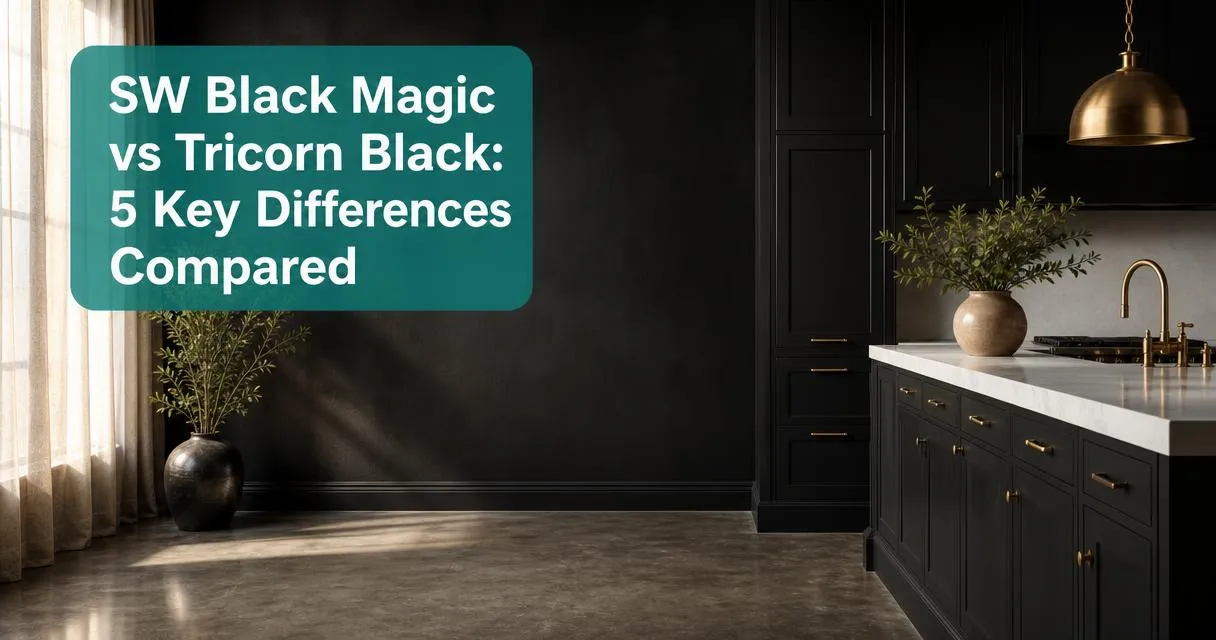
Choosing between Black Magic and Tricorn Black comes down to whether you want warmth or neutrality in your black. Black Magic (SW 6991) leans warmer with subtle brown and green undertones, while Tricorn Black (SW 6258) stays cooler and more neutral. Neither is objectively better, but your room’s lighting, existing palette, and desired mood will make one clearly right for your project.
Key Takeaways
- Black Magic (SW 6991) reads warmer with brown undertones that add character but can look muddy in certain light
- Tricorn Black (SW 6258) stays neutral with minimal undertone, delivering a true black for modern and traditional spaces
- LRV difference is small (Black Magic 2.13, Tricorn Black 1.88) but Tricorn appears deeper in low light
- Both work on cabinets, trim, and exteriors, but undertone matters most when choosing
- Black Magic warms visibly in direct sunlight on exteriors, while Tricorn can flash slightly cooler
- Tricorn pairs cleanly with cool grays and whites, Black Magic harmonizes better with warm whites like Benjamin Moore White Dove
- Use satin or semi-gloss on cabinets and trim for both colors, flat or eggshell on walls to minimize imperfections
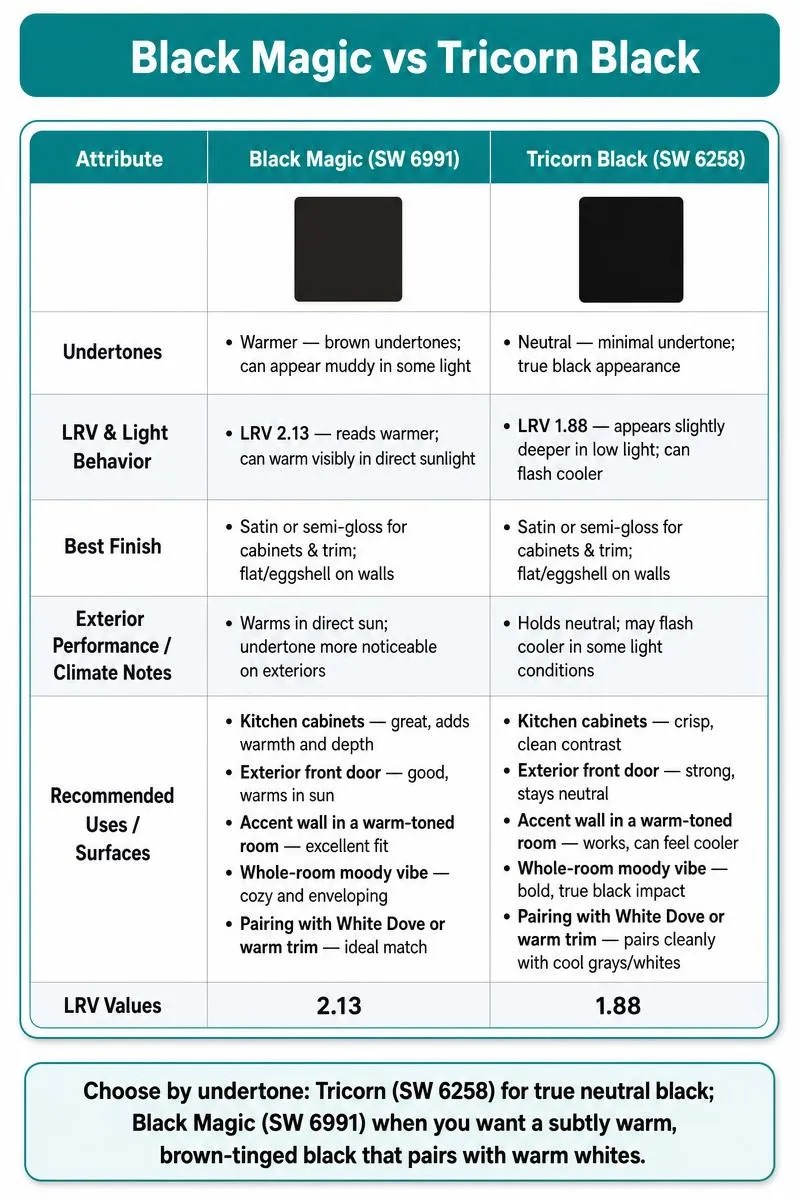
Black Magic Vs Tricorn Black at a Glance
| Attribute | Black Magic (SW 6991) | Tricorn Black (SW 6258) |
|---|---|---|
| Undertones | Warmer — brown undertones; can appear muddy in some light | Neutral — minimal undertone; true black appearance |
| LRV & Light Behavior | LRV 2.13 — reads warmer; can warm visibly in direct sunlight | LRV 1.88 — appears slightly deeper in low light; can flash cooler |
| Best Finish | Satin or semi-gloss for cabinets & trim; flat/eggshell on walls | Satin or semi-gloss for cabinets & trim; flat/eggshell on walls |
| Exterior Performance / Climate Notes | Warms in direct sun; undertone more noticeable on exteriors | Holds neutral; may flash cooler in some light conditions |
| Recommended Uses / Surfaces |
|
|
| LRV Value | 2.13 | 1.88 |
Quick Comparison
- Black Magic (SW 6991) carries an LRV of 2.13 with brown and green undertones that warm up in direct sunlight. Best in satin or semi-gloss on exterior doors, accent walls, and kitchen islands with warm tones.
- Tricorn Black (SW 6258) carries an LRV of 1.88 with minimal undertone that reads as true black in most lighting. Best in flat or eggshell on walls and satin on trim for modern cabinetry and moody bedrooms.
- Both paints perform across cabinets, trim, and exteriors, but undertone drives the choice more than surface type or sheen.
Related Reading
Benjamin moore onyx comparison
A direct comparison of Benjamin Moore Onyx and Sherwin‑Williams Tricorn Black that highlights undertones and depth…
What Is Black Magic SW 6991?
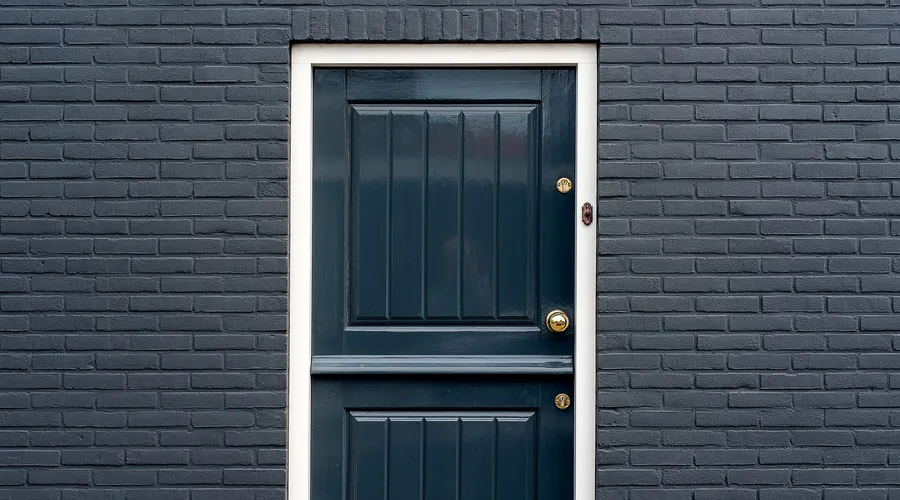
Black Magic is a warm-leaning black with subtle brown and green undertones that give it depth and richness. Use it in spaces where you want black to feel approachable rather than stark, like kitchen islands, accent walls in living rooms, or exterior front doors.
The warmth shows most in north-facing rooms or spaces with cooler natural light, where it prevents feeling too cold. On kitchen islands paired with warm wood floors or brass hardware, Black Magic adds weight without harsh contrast. Exterior use brings out the warmth even more. Sunlight brings out brown or green undertones on front doors and shutters, giving them a softer, richer appearance than cooler blacks.
The weakness is inconsistency under mixed lighting. In rooms with both natural daylight and warm artificial light, Black Magic can shift from true black to almost charcoal-brown. Some homeowners notice a slight greenish cast on walls adjacent to windows. If you’re after a black that stays consistent across all conditions, this isn’t it.
What Is Tricorn Black SW 6258?
Tricorn Black is as close to a neutral, true black as Sherwin Williams offers, with almost no detectable undertone in most lighting. It works in modern kitchens, moody bedrooms, painted ceilings, and trim where you want maximum contrast without color shift.
Tricorn pairs universally because it doesn’t introduce warm or cool tones that clash with your existing palette. It anchors spaces with bright white trim, cool gray walls, or even warmer beiges without looking out of place. On cabinetry, it creates sharp lines and depth, especially in matte or satin finishes that don’t reflect undertones the way glossier blacks can.
It can feel cold in the wrong context. In rooms with warm wood tones, terracotta, or honey-colored lighting, Tricorn can feel stark or flat rather than rich.
It lacks the subtle warmth that makes Black Magic feel lived-in. If your space already skews cool or minimal, Tricorn reinforces coolness rather than softening it.
Head-to-Head
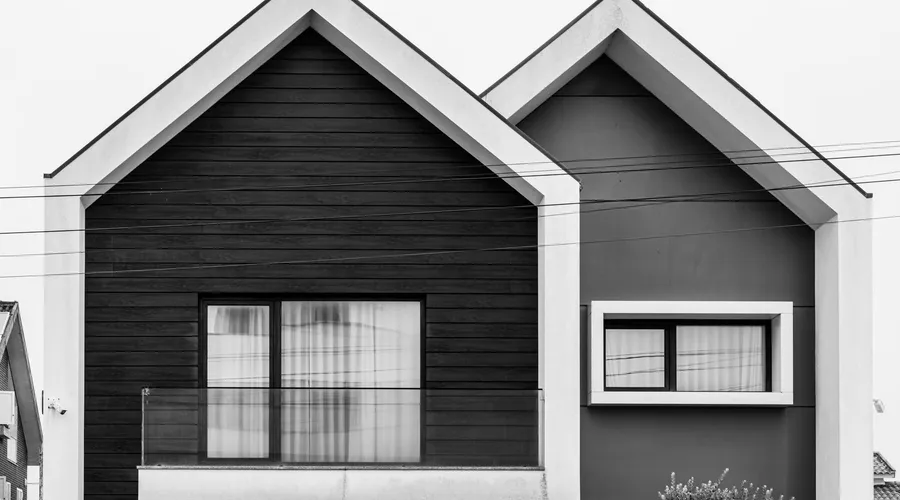
Both paints read as dark, rich blacks on a swatch, but five factors separate them in real rooms. Undertone, light behavior, finish, exterior exposure, and color pairing each push one paint ahead depending on your space.
1. Undertones
Black Magic carries brown and green undertones that become visible in natural light, especially near windows or on exterior surfaces. Tricorn Black stays neutral with barely any detectable undertone, reading as true black in most conditions.
Your palette determines the winner: if you have warm whites, wood tones, or brass fixtures, Black Magic integrates smoothly. If you’re working with cool grays, chrome hardware, or stark white trim, Tricorn avoids clashing.
In mixed-use spaces where lighting changes throughout the day, Tricorn maintains consistency while Black Magic shifts slightly warmer in afternoon sun and cooler under LED bulbs.
2. LRV & Light Behavior
Black Magic has an LRV of 2.13, Tricorn Black sits at 1.88. The difference is small but visible in low-light conditions. Tricorn absorbs slightly more light and appears deeper in hallways, powder rooms, or north-facing spaces.
In bright rooms with large windows, both read as dark but Black Magic reflects a bit more warmth, softening the overall effect.
Under artificial light, Black Magic responds more to bulb temperature. Warm Edison bulbs or 2700K LEDs pull out the brown undertones, while daylight-balanced bulbs (5000K) push it cooler. Tricorn stays stable across light sources, making it easier to predict the final look without extensive sampling.
3. Best Finish
Both colors perform well in flat, eggshell, satin, and semi-gloss, but the surface drives the choice:
- Use flat or eggshell on walls to hide drywall imperfections and minimize sheen that can highlight undertones
- On trim, doors, and cabinetry, satin or semi-gloss adds durability and a slight reflective quality that enhances depth
- Black Magic in semi-gloss can emphasize warm undertones, especially on glossy cabinet doors under pendant lights
- Tricorn in the same finish stays cleaner and sharper in semi-gloss applications
- If painting an entire room, matte or eggshell prevents feeling heavy or overly reflective
4. Exterior Performance
Black Magic warms noticeably in direct sunlight. Brown and green undertones come forward on front doors, shutters, and siding, giving a softer, richer black that pairs well with brick, stone, and warm-toned landscaping.
Tricorn Black stays truer to a neutral black but can flash slightly cooler in full sun. This works better with modern exteriors, white or gray siding, and minimalist design.
Heat absorption is identical since both are dark paints with similar LRVs, so fading and surface temperature aren’t deciding factors. The choice is purely visual: Black Magic for curb appeal with character, Tricorn for clean, contemporary contrast.
5. Color Scheme Pairing
Tricorn Black pairs cleanly with cool whites and grays:
- Sherwin Williams Pure White or Extra White for crisp contrast
- Repose Gray or Agreeable Gray for coordinated cool tones
- Chrome, stainless steel, or blue-toned decor without clashing
Black Magic harmonizes with warm whites and earthy materials:
- Benjamin Moore White Dove, Sherwin Williams Alabaster, or cream trim
- Warm wood tones, brass hardware, and earthy color palettes
- Brick, stone, and warm-toned landscaping on exteriors
If your space already has a defined temperature, match it. Tricorn clashes with warm palettes and creates uncomfortable contrast. Black Magic in a cool, modern space may look muddied or out of place.
Related Reading
Practical guidance on durable paints and finishes for exterior doors, useful if you plan to use Black Magic or Tricorn…
Which Should You Choose?
Five common painting scenarios break down differently for each color. Your surface, existing palette, and desired mood determine which black comes out ahead.
1. Kitchen Cabinets
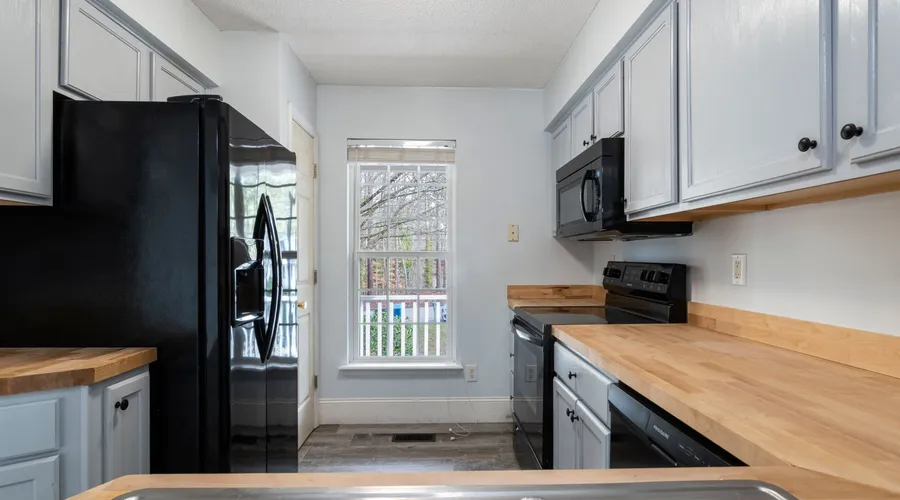
Tricorn Black delivers a crisp, modern look that pairs with stainless appliances, white countertops, and cool-toned backsplash. The neutral undertone prevents color shift. It works whether your counters are marble, quartz, or concrete.
2. Exterior Front Door
Black Magic adds warmth and curb appeal, especially on homes with brick, warm siding, or natural wood accents. The brown undertones soften the black in sunlight, making the door feel intentional rather than stark.
3. Accent Wall in a Warm-Toned Room
Black Magic integrates with existing beige, terracotta, or honey tones without creating harsh contrast. It adds depth while staying within the room’s temperature range, making the accent wall feel cohesive with surrounding colors.
4. Whole-Room Moody Vibe
Tricorn Black provides clean, consistent depth across all walls without the color shift you’d get from Black Magic. It works especially well in bedrooms or media rooms where you want true darkness without warmth that can muddy the effect.
5. Pairing with White Dove or Warm Trim
Black Magic matches the warmth of White Dove or Alabaster trim, creating a harmonious contrast that doesn’t fight the undertones. Tricorn would read too cool against warm whites and create visual tension.
FAQs
What is the color number for Tricorn Black?
Tricorn Black is SW 6258. It’s one of Sherwin Williams’ most popular true blacks and popular in modern kitchens and exterior trim.
What undertones does Black Magic have vs Tricorn Black?
Black Magic has brown and green undertones that show in natural light and on exteriors. Tricorn Black stays neutral with minimal undertone, reading as true black in most conditions.
Which black is better for kitchen cabinets?
Tricorn Black works better in modern kitchens with cool-toned finishes and stainless appliances. Black Magic suits kitchens with warm wood floors, brass hardware, or cream-colored walls where the warmth integrates smoothly.
Can I use Black Magic or Tricorn Black on a home exterior?
Both work on exteriors, but Black Magic warms in sunlight and pairs better with brick or warm siding. Tricorn stays truer to neutral black and fits modern or cool-toned exteriors.
What finish should black walls be: flat, eggshell, or satin?
Use flat or eggshell on walls to hide imperfections and reduce sheen. Save satin or semi-gloss for trim, doors, and cabinets where durability and slight reflectivity add depth.
How do these compare to SW Iron Ore and Caviar?
Iron Ore (SW 7069) is a dark charcoal gray, lighter than both and with gray undertones. Caviar (SW 6990) is a cooler black than Black Magic but slightly warmer than Tricorn, sitting between the two in neutrality.
Final Verdict
Pick Tricorn Black if you want a neutral, true black that stays consistent across lighting conditions and pairs with cool whites, grays, and modern finishes. It’s the safer choice for cabinetry, trim, and spaces where you need predictable depth without color shift.
Pick Black Magic if your room already leans warm or you want a black with character that integrates with wood tones, brass, and earthy palettes. It works especially well on exterior doors and accent walls where warmth adds richness rather than muddiness.
Buy sample pots of both and paint large swatches on your wall. Observe them at different times of day under your actual lighting. The undertone difference is subtle in the can but obvious on the wall. Testing in your space is the only way to know which one feels right.
If you are in the Fish Hawk metro area and want help choosing between Black Magic and Tricorn Black or testing samples in your home’s specific lighting, we offer free color consultations for local homeowners. We’ll walk you through how each color performs on siding, trim, and doors, so you can see which one reads best on your house. To schedule a visit call 813-860-8661 or review our exterior painting services for what the consultation includes.
Related Reading
Best paint colors for furniture
Inspiration and finish recommendations for painting furniture and cabinetry—handy when considering these blacks for…