
Transparent deck stains let you showcase your wood grain while providing water repellency, but they offer minimal UV protection compared to any other stain category. You’ll get one to two years of coverage before reapplication, sometimes less in harsh climates.
The right choice depends on several factors. Wood type drives stain selection since hardwoods and softwoods absorb stain differently. Your maintenance tolerance and cleanup preferences also play a role.
Key Takeaways
- Transparent stains provide minimal UV protection compared to semi-transparent or solid stains, typically lasting 1 – 2 years before reapplication is needed
- Softwoods like pressure-treated pine require more frequent recoating than hardwoods like cedar or redwood because softwoods absorb moisture and degrade faster
- Oil-based stains penetrate deeper for longer protection, while water-based formulas offer easier cleanup and lower VOC emissions
- TWP 100 and Cabot Clear Wood Protector consistently earn the highest ratings from both professional contractors and DIY homeowners
- Surface prep including cleaning, brightening, and complete drying matters more than brand selection for stain longevity
- Florida and other high-humidity climates cut transparent stain lifespan in half, often requiring annual maintenance
- Water-based transparent stains can usually be recoated without stripping, while oil-based products often require complete removal before reapplication
Related Reading
A practical guide to choosing deck stain colors and how different tones look on wood—helpful for picking the right…
Comparing the Top Best Transparent Deck Stain
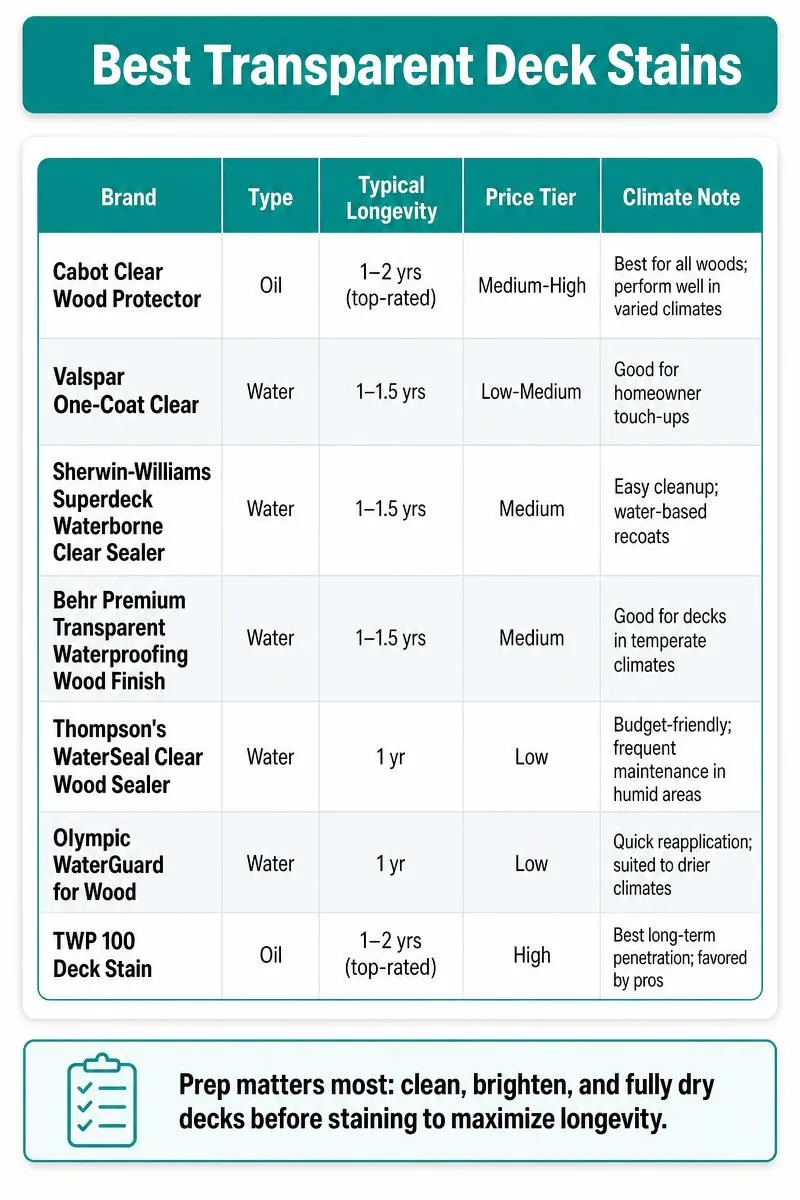
| Brand | Type | Typical Longevity | Price Tier | Climate Note |
|---|---|---|---|---|
| Cabot Clear Wood Protector | Oil | 1–2 yrs (top-rated) | Medium-High | Best for all woods; perform well in varied climates |
| Valspar One-Coat Clear | Water | 1–1.5 yrs | Low-Medium | Good for homeowner touch-ups |
| Sherwin-Williams Superdeck Waterborne Clear Sealer | Water | 1–1.5 yrs | Medium | Easy cleanup; water-based recoats |
| Behr Premium Transparent Waterproofing Wood Finish | Water | 1–1.5 yrs | Medium | Good for decks in temperate climates |
| Thompson’s WaterSeal Clear Wood Sealer | Water | 1 yr | Low | Budget-friendly; frequent maintenance in humid areas |
| Olympic WaterGuard for Wood | Water | 1 yr | Low | Quick reapplication; suited to drier climates |
| TWP 100 Deck Stain | Oil | 1–2 yrs (top-rated) | High | Best long-term penetration; favored by pros |
Quick Comparison
- TWP 100 Deck Stain: Oil base, moderate UV protection (best in transparent category), 18 – 24 month lifespan. Penetrates deepest for longest protection on cedar and redwood decks.
- Cabot Clear Wood Protector: Oil base (linseed oil formula), moderate UV protection, 15 – 20 month lifespan. Works on hardwoods and softwoods for general-purpose use.
- Sherwin-Williams Superdeck Waterborne Clear Sealer: Water base, low-moderate UV protection, 12 – 18 month lifespan. Mildewcides prevent black spotting in damp, shaded areas.
- Behr Premium Transparent Waterproofing Wood Finish: Water base, low UV protection, 12 – 15 month lifespan. Penetrates better than standard sealers on new pressure-treated decks.
- Valspar One-Coat Clear: Water base, low UV protection, 10 – 14 month lifespan. Protects adequately at lower cost for budget projects.
- Olympic WaterGuard for Wood: Water base, minimal UV protection, 8 – 12 month lifespan. Provides decent water repellency on a tight budget.
- Thompson’s WaterSeal Clear Wood Sealer: Water base, minimal UV protection, 6 – 10 month lifespan. Offers basic short-term protection with wide retail availability.

What Is a Transparent Deck Stain?
A transparent deck stain contains minimal pigment, allowing the full natural grain and color of your wood to show through while providing water repellency and mild UV inhibitors. Unlike semi-transparent or solid stains that add visible color, transparent formulas function primarily as protective sealers that preserve the wood’s original appearance.
These stains work best on new or freshly cleaned cedar, redwood, and pressure-treated pine where you want to maintain the natural wood look. New or replacement deck boards show the most dramatic results because the wood grain is still distinct and unstained by weathering.
The main advantage is the natural aesthetic without visible lap marks or wear patterns. Application is straightforward since minor coverage inconsistencies don’t create color variations. Most transparent stains recoat without extensive stripping, especially water-based versions.
The significant downside is lifespan. Transparent stains have the shortest protective window of any deck finish, requiring reapplication every one to two years depending on sun exposure and foot traffic.
Wood in full sun fades to gray faster than shaded areas. High-traffic zones lose water repellency first, often within the first year even when the rest of the deck still beads moisture.
7 Transparent Deck Stains Reviewed
Each product balances penetration depth, UV inhibitors, ease of application, and cost differently. Here is how the seven options compare.
1. Cabot Clear Wood Protector
This oil-based formula uses linseed oil as the primary carrier, giving it strong penetration on both hardwoods and softwoods. The linseed oil formula penetrates deeply without surface film, which helps prevent peeling as the coating ages. You’ll get 15 to 20 months of protection on horizontal deck surfaces in moderate climates.
Application requires mineral spirits for cleanup, and the formula has a noticeable odor during drying. Coverage runs about 200 square feet per gallon on typical pressure-treated pine, less on rough-sawn cedar. Reapplying within the maintenance window requires only light sanding, not full stripping.
2. Valspar One-Coat Clear
This water-based option targets budget-conscious homeowners who want decent protection without premium pricing. The formula applies smoothly with easy cleanup using a brush or pad applicator. Expect 10 to 14 months before water stops beading on horizontal surfaces.
UV inhibitors are minimal compared to oil-based competitors, so wood in direct sun will start graying faster. The product works adequately on new pressure-treated decks where you plan to restain annually. Coverage is around 250 square feet per gallon on smooth lumber, and the low-VOC formula reduces odor during application.
3. Sherwin-Williams Superdeck Waterborne Clear Sealer
Professional contractors use this water-based sealer when clients want low-VOC products with enhanced mildew resistance. The formula includes mildewcides that prevent spotting in damp areas common under deck furniture or near plantings. You’ll see 12 to 18 months of water repellency in typical residential applications.
The product costs more per gallon than big-box alternatives but covers well at about 225 square feet per gallon. Application goes faster than oil-based stains since there’s no mineral spirits cleanup. You can apply a second coat within two hours, and recoating requires only scuff-sanding.
4. Behr Premium Transparent Waterproofing Wood Finish
Home Depot’s premium transparent option offers solid performance on new decks where wood is clean and porous. The water-based formula penetrates better than standard sealers, giving you 12 to 15 months before recoating. The product includes mild tinting options if you want a barely perceptible warm or cool tone.
Coverage is efficient at roughly 250 square feet per gallon on factory-smooth pressure-treated lumber. Application with a synthetic brush or roller pad produces even results without lap marks. The formula dries fast for same-day use, usually within four hours in warm weather.
5. Thompson’s WaterSeal Clear Wood Sealer
This entry-level sealer is available everywhere from hardware stores to grocery chains, making it convenient for quick projects. The water-based formula provides basic water repellency but has the shortest lifespan in this comparison at 6 to 10 months. UV protection is almost nonexistent, so wood grays within one season.
The low price point makes sense if you’re sealing a small deck or testing the transparent look before investing in a premium product. Coverage runs about 200 square feet per gallon.
Cleanup is easy with water. The thin consistency means fewer brush marks, though it also means less protective surface buildup.
6. Olympic WaterGuard for Wood
This budget water-based option sits between Thompson’s and mid-tier products in both price and performance. Water repellency is decent for the cost, with beading lasting 8 to 12 months on horizontal surfaces. UV inhibitors are weak, so wood grays gradually in full sun.
The formula works adequately on pressure-treated pine and other softwoods where frequent reapplication is already expected. Coverage is about 225 square feet per gallon, and the low-odor formula allows staining with windows open. It fills the gap when you need temporary protection on tight budgets.
7. TWP 100 Deck Stain
Professional deck builders favor this oil-based transparent stain for deep penetration and extended lifespan. The formula soaks into wood fibers rather than forming a surface film, which means no peeling as stain wears. You’ll get 18 to 24 months of protection on cedar and redwood, the longest window of any transparent product.
The tradeoff is price and application effort. TWP 100 costs significantly more per gallon than water-based alternatives. The oil formula requires mineral spirits for cleanup.
Coverage is around 150 to 200 square feet per gallon depending on wood porosity. The product requires completely dry wood for proper penetration and bonding, ideally 12% moisture content or lower. This means waiting for dry weather before application.
Related Reading
Best semi transparent deck stains
Detailed comparisons of top semi-transparent deck stains, useful if you’re weighing transparent versus semi-transparent…

Head-to-Head: Oil-Based vs Water-Based Transparent Stains
The two categories differ across durability, application, environmental impact, and reapplication logistics.
- Durability: Oil-based stains penetrate deeper into wood cells because oil carriers have smaller molecular size. This extends the protective window by six to eight months compared to water-based products on the same deck.
- Application and cleanup: Water-based formulas wash out with soap and water, no mineral spirits needed. They also dry faster, often in two to four hours versus overnight for oil products.
- Environmental impact: Water-based stains contain low or zero VOCs, meeting strict air quality regulations in California and northeastern states. Oil-based products have higher VOC content that contributes to ground-level ozone and may be restricted in some jurisdictions.
- Reapplication: Water-based stains can usually be recoated with just cleaning and light scuff-sanding. Oil-based products often require complete stripping when weathered because oxidized oil prevents new stain from penetrating.
Which Should You Choose?
Different priorities point to different products. Here are the main scenarios:
- For new cedar or redwood decks where you want maximum time between reapplications: Choose TWP 100 or Cabot Clear Wood Protector. Oil-based penetration delivers the longest protective window in a transparent formula. Plan for mineral spirits cleanup and overnight drying.
- For budget-conscious homeowners with pressure-treated pine: Choose Valspar One-Coat Clear or Olympic WaterGuard. These water-based options cost less per gallon and match softwood recoating schedules. Easy cleanup and fast drying make annual maintenance less burdensome.
- For low-VOC or eco-conscious projects: Choose Sherwin-Williams Superdeck Waterborne Clear Sealer. The mildew resistance prevents spotting in humid climates or shaded areas. Performance sits closer to oil-based products while maintaining water-based environmental benefits.
- For quick weekend projects with minimal prep: Choose Behr Premium Transparent Waterproofing Wood Finish. The formula dries fast for same-day completion and is available at any Home Depot. Convenience matters when working around family schedules and weather windows.
FAQs
What is the best transparent deck stain according to consumer reports?
Consumer Reports doesn’t regularly test transparent deck stains as a standalone category, instead focusing on semi-transparent and solid stains with better UV protection. Among professional and DIY user reviews across forums and retail sites, TWP 100 and Cabot Clear Wood Protector consistently score highest for longevity and ease of application.
What deck stain do professionals use most often?
Professional deck contractors typically use TWP 100 for transparent applications and semi-transparent oil-based stains for clients who want longer-lasting color. The deeper penetration reduces callback visits for peeling, which protects the contractor’s reputation even though the product costs more upfront.
How long does transparent deck stain last compared to semi-transparent?
Transparent stains last one to two years on horizontal surfaces, while semi-transparent stains block more UV with pigment to extend that to two to four years. The additional pigment particles provide more UV blockers, which slows wood degradation and moisture cycling that breaks down the protective coating.
Can you apply transparent stain over an old semi-transparent stain?
No, transparent stain applied over semi-transparent won’t penetrate properly and will fail quickly. The pigment layer from the semi-transparent product blocks absorption, leaving the new transparent stain sitting on the surface where it peels within months of application. You’d need to strip back to bare wood or stick with semi-transparent formulas.
Does transparent deck stain protect against UV damage?
Transparent stains provide minimal UV protection compared to pigmented options. They include mild UV inhibitors that slow graying slightly, but wood will still fade to silver-gray over one to two seasons of direct sun exposure. The primary protection comes from water repellency, not UV blocking.
What happens if you don’t prep the deck before staining?
Stain applied over dirt, mildew, or mill glaze won’t penetrate or adhere properly. You’ll see premature peeling, uneven water beading, and significantly reduced lifespan, often failing within six months instead of the expected 12 to 24 months. Cleaning and brightening doubles any stain’s effectiveness.
Final Verdict
TWP 100 outlasts every transparent competitor, especially on cedar and redwood where the premium wood justifies the premium stain cost. If you’re willing to handle oil-based cleanup and wait for proper wood drying before application, you’ll get 18 to 24 months between coats.
Behr Premium Transparent or Valspar One-Coat Clear make more sense for standard pressure-treated decks where you’re prioritizing budget and ease of annual maintenance. The water-based formulas won’t outlast oil products, but fast application and cleanup suit frequent softwood maintenance.
Before committing to five gallons, buy sample cans of your top two choices and test them on an inconspicuous deck area. Testing on scrap lumber from the same species prevents costly product mistakes by showing exactly how each formula handles your wood and application style.
Located in Fish Hawk, Florida, we serve homeowners throughout the Tampa metro area where heat and humidity shorten transparent stain lifespan and often require annual reapplication. If you need help choosing a stain or applying it, our deck refinishing services can assess your wood and recommend the right product for Florida conditions. Call us at 813-860-8661 to schedule an on-site evaluation or discuss options.