
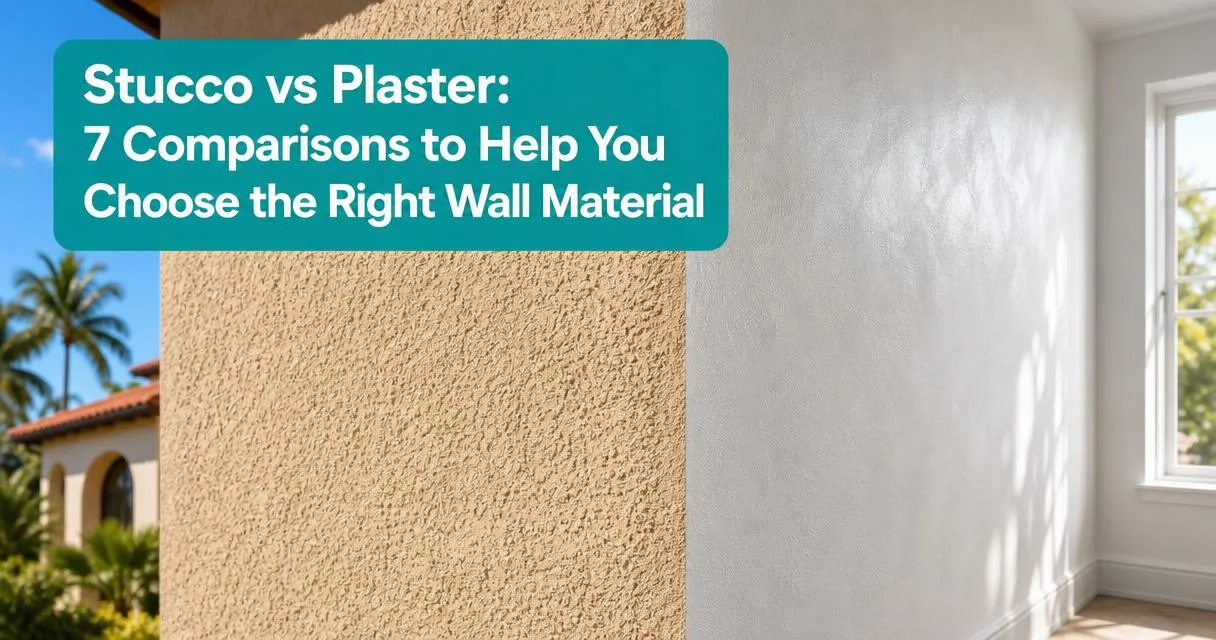
You’re standing in front of a cracked exterior wall or planning an interior renovation, and someone’s told you to use stucco, or maybe it was plaster? They sound interchangeable, but using the wrong one means costly repairs and poor adhesion, or a finish that fails within a few years.
There’s no single right answer here. The better choice depends on whether you’re working indoors or outdoors, what your climate looks like, and what kind of finish you actually want.
This article walks through 7 direct comparisons covering composition, durability, cost, moisture handling, appearance, insulation, and repair. Use them to narrow your options before calling a contractor.
Key Takeaways
- Stucco is cement-based and designed for exterior walls; plaster is gypsum or lime-based and built for interior surfaces
- Stucco handles rain, UV exposure, and temperature swings; plaster degrades quickly when exposed to sustained moisture
- Plaster’s smooth troweled finish is the reason high-end interior renovations still call for three-coat or skim-coat application: no paint product replicates the same surface depth
- Patching stucco seamlessly is harder than repairing plaster cracks with lime putty or joint compound
- Labor drives cost for both materials, not just the product itself: get quotes that include substrate prep
- If you’re repairing an existing wall, match the original material; mixing stucco over plaster or vice versa creates adhesion problems
- Quick answer: choose stucco for exterior durability, choose plaster for interior finish quality
Related Reading
Exterior paint finish for stucco
A practical guide to the best paint finishes and coatings specifically for stucco exteriors, useful for readers…

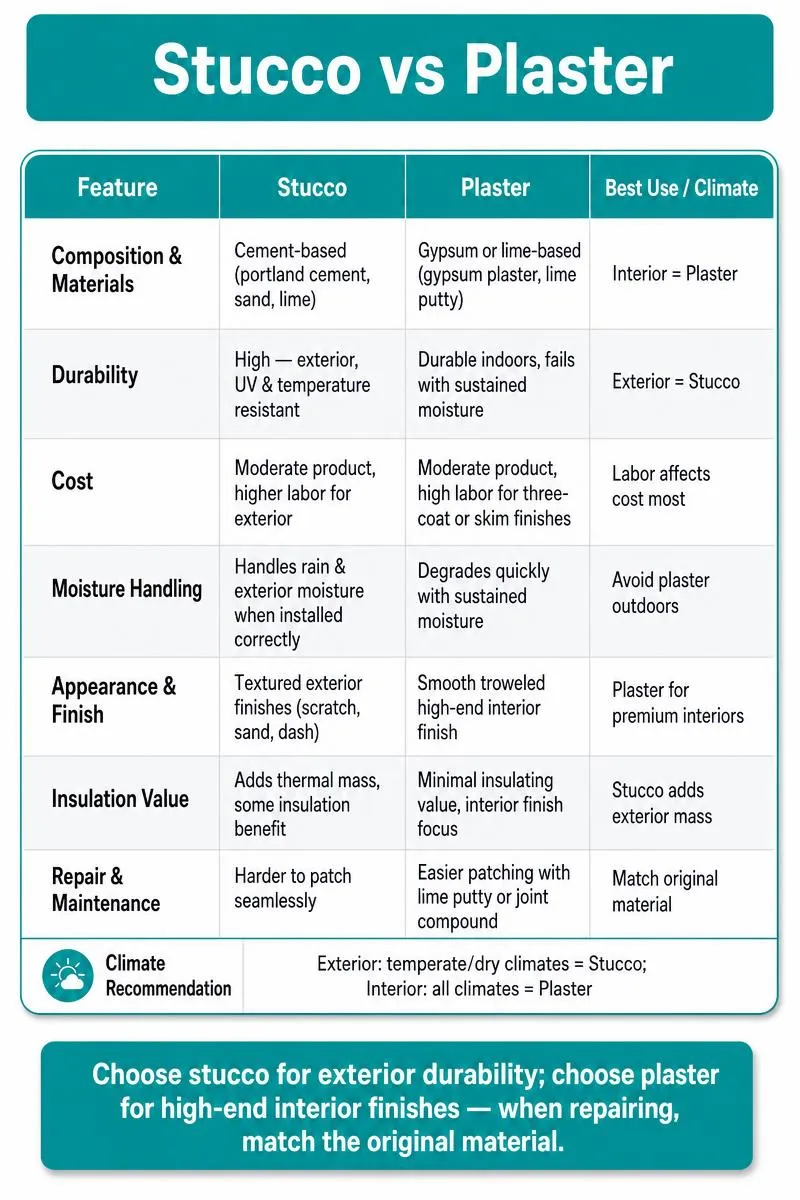
Stucco Vs Plaster Side-by-Side
| Feature | Stucco | Plaster | Best Use / Climate |
|---|---|---|---|
| Composition & Materials | Cement-based (portland cement, sand, lime) | Gypsum or lime-based (gypsum plaster, lime putty) | Interior = Plaster |
| Durability | High — exterior, UV & temperature resistant | Durable indoors, fails with sustained moisture | Exterior = Stucco |
| Cost | Moderate product, higher labor for exterior | Moderate product, high labor for three-coat or skim finishes | Labor affects cost most |
| Moisture Handling | Handles rain & exterior moisture when installed correctly | Degrades quickly with sustained moisture | Avoid plaster outdoors |
| Appearance & Finish | Textured exterior finishes (scratch, sand, dash) | Smooth troweled high-end interior finish | Plaster for premium interiors |
| Insulation Value | Adds thermal mass, some insulation benefit | Minimal insulating value, interior finish focus | Stucco adds exterior mass |
| Repair & Maintenance | Harder to patch seamlessly | Easier patching with lime putty or joint compound | Match original material |
| Climate Recommendation | Exterior: temperate/dry climates = Stucco; Interior: all climates = Plaster |
Quick Comparison Table
Here’s how the two materials stack up across the dimensions that matter most for your decision:
- Composition: Stucco uses cement, sand, lime, and water; plaster uses gypsum, lime, or clay
- Best use: Stucco for exterior walls and facades; plaster for interior walls and ceilings
- Durability: Stucco withstands outdoor weather cycles; plaster resists indoor impact and wear
- Moisture handling: Stucco is breathable and weather-resistant; plaster is water-sensitive and degrades with prolonged exposure
- Cost: Stucco typically costs more per square foot due to thicker application and wire mesh substrate; plaster costs less per square foot than stucco for skim coat applications, while three-coat plaster approaches stucco labor costs
- Finish options: Stucco offers dash, sand, and skip-trowel textures; plaster delivers smooth, polished, or Venetian finishes
- Repair difficulty: Stucco patches are hard to blend invisibly; plaster cracks can be filled with lime putty and finished cleanly
What Is Stucco?
Stucco is a mixture of Portland cement, sand, lime, and water applied in two or three coats over a wire mesh lath attached to the wall framing or masonry. The mesh gives it something to grip, and the layered application of scratch, brown, and finish coats builds up a thick, durable surface on a standard exterior wall.
It’s used almost exclusively on exterior surfaces. The cement base makes it breathable, meaning moisture vapor can pass through without building up inside the wall. That breathability is one of the reasons it’s popular in warm, dry climates like the American Southwest.
It also performs well in Florida’s heat and humidity when properly installed and sealed. Stucco resists fire and wind-driven rain without needing repainting as often as wood siding.
It cracks when a home settles or shifts, and matching the original texture when patching is genuinely difficult. Mismatched patches are one of the most common stucco complaints.
What Is Plaster?
Plaster is a gypsum, lime, or clay-based material troweled directly onto interior walls and ceilings, either over a wood or metal lath or applied as a skim coat on top of drywall. Traditional three-coat plaster (scratch, brown, and finish coats) creates a dense, hard surface that resists dents and impacts that would crack standard drywall. A skim coat of finish plaster over drywall is thinner but still delivers a smoother result than paint alone.
Plaster’s main advantage is its finish quality. A skilled plasterer can produce a surface so smooth it looks polished, and decorative techniques like Venetian plaster add depth paint can’t replicate. It’s also lighter than stucco and doesn’t require heavy substrate reinforcement.
The trade-off is moisture sensitivity. Water behind a plaster wall breaks down the gypsum binder, causing it to lose its bond to the lath. The result is bulging, cracking, and eventual collapse of affected sections.
It’s also prone to cracking with building movement, though those cracks are generally easier to repair than stucco damage.
Related Reading
Limewash vs plaster comparison
A focused comparison of limewash and plaster that expands on breathable, traditional finishes and how they perform on…
Head-to-Head: 7 Comparisons
The right material is almost always obvious once you know which surface you’re working on and what your climate demands.
1. Composition and Materials
Stucco is built around Portland cement as its binder, combined with sand for texture and body, and lime to improve workability and flexibility. Some modern stucco mixes include acrylic or polymer additives that improve crack resistance and allow for a wider range of colors without painting.
Plaster relies on gypsum as its primary binder in most modern applications, though lime plaster, made from slaked lime and sand, is the traditional formulation and is still used in historic restoration. Clay plaster is a third option, popular in natural building and eco-conscious renovations. The binder determines how the material behaves:
- Gypsum sets quickly and hard for fast installation and a dense surface
- Lime stays slightly flexible and self-heals minor cracks over time
- Clay is the most breathable of the three but also the least moisture-resistant
2. Durability
For exterior exposure including UV rays, rain, freeze-thaw cycles, and wind, stucco is the clear winner. A properly applied three-coat stucco system over wire mesh can last for decades with minimal maintenance. The cement base resists impact better than wood siding, and it doesn’t rot or attract termites.
For interior walls, plaster holds its own. Hard-coat plaster resists dents and dings that would mark standard drywall. That’s why older plaster homes feel noticeably more solid.
The durability comparison flips completely indoors: plaster outperforms stucco because stucco’s coarse texture and cement base make it unsuitable for interior living spaces.
3. Cost
Cost for both materials is driven more by labor than product price. Stucco application requires skilled workers, multiple coats with drying time between each, and wire mesh installation. These requirements add up fast.
Plaster work, particularly traditional three-coat plaster or decorative Venetian finishes, is also skilled labor and commands higher rates than standard drywall finishing.
For a rough comparison: stucco on exterior walls costs more than vinyl siding but is competitive with brick and stone in many markets. Plaster skim coat over existing drywall is less expensive than full three-coat plaster, and it’s one of the more cost-effective ways to upgrade interior wall quality. Get itemized quotes that separate material, labor, and substrate prep: that’s where cost surprises usually hide.
4. Moisture Handling
Stucco is designed to handle exterior moisture. Its cement base is breathable, meaning water vapor passes through rather than getting trapped. This prevents mold and rot you’d get with a vapor-impermeable coating.
Stucco sheds liquid water at the surface while allowing the wall assembly to dry out after rain. In Florida’s climate, proper flashing and weep screeds at the base are critical to keeping moisture from wicking behind the stucco layer.
Plaster fails quickly with direct or prolonged water exposure. Water behind a plaster wall breaks down the gypsum binder and causes it to lose its bond to the lath, leading to bulging, cracking, and eventual collapse of sections.
Lime plaster is somewhat more moisture-tolerant than gypsum plaster. It’s the reason lime was the standard for centuries in bathrooms and kitchens before modern waterproofing products existed. Neither lime nor gypsum plaster belongs on an exterior wall.
5. Appearance and Finish Options
Stucco offers a range of textures: dash finish (sprayed on for a rough, pebbly look), sand finish (a medium texture common in Florida residential construction), float finish (smoother but still textured), and skip-trowel (a hand-applied pattern that varies by applicator). Color can be integral to the mix or applied as paint over a cured finish coat. Smooth stucco does exist but is less forgiving of imperfections in the substrate.
Plaster wins on finish refinement. A skilled plasterer can deliver a glass-smooth surface that takes paint beautifully, or apply Venetian plaster for a polished, marble-like appearance. Marmorino and tadelakt build depth and richness that paint alone can’t achieve, which is why they’re increasingly popular in high-end interiors.
If the goal is a refined interior wall, plaster is the right tool.
6. Insulation Value
Stucco adds thermal mass to an exterior wall. Thermal mass absorbs and releases heat slowly, which helps moderate indoor temperatures in climates with significant day-to-night temperature swings. In Florida’s more consistent heat, the thermal mass benefit is less dramatic, but the stucco layer still contributes to the overall wall assembly’s energy performance.
Plaster provides minimal insulation value on its own. The insulation inside the wall cavity is what actually handles a home’s thermal performance.
Even a single inch of rigid foam board in the wall cavity outperforms plaster’s thermal contribution by an order of magnitude. If energy efficiency is your priority, focus on what’s inside the wall, not the finish coat.
7. Repair and Maintenance
Stucco repair is the more frustrating of the two. When cracks appear from settling or impact, you need to cut out the damaged section, apply new scratch and brown coats, and finish with a texture that matches the original. Matching existing stucco texture by hand is difficult even for experienced plasterers.
That’s why patched stucco often looks noticeably different, especially after the patch weathers at a different rate than the surrounding material.
Plaster repairs are more forgiving. Hairline cracks can be filled with lime putty and sanded smooth. Larger cracks may need fiberglass mesh tape and a skim coat of joint compound.
Because plaster repairs happen indoors and get painted over, the repaired surface blends invisibly under paint. Regular maintenance for stucco means inspecting caulk joints around windows and doors annually and repainting the finish coat as needed depending on sun exposure.
Which Should You Choose?
The right choice is almost always determined by location: where on the home, and where in the country.
- Exterior walls in hot or humid climates: Stucco is the right call. It handles moisture and UV exposure without degrading. In Fish Hawk and the broader Tampa Bay area, stucco has been the standard exterior finish for decades for exactly this reason.
- Interior walls wanting a smooth decorative finish: Plaster, either full three-coat or a skim coat over drywall. No other material delivers unmatched surface quality for paint or decorative finishes.
- Budget-conscious homeowner comparing options: Weigh material and labor separately. A plaster skim coat interior upgrade is often more affordable than a full stucco re-coat on an exterior. Get quotes that include substrate prep so you’re comparing equivalent scopes.
- Repairing existing cracked walls: Match what’s already there. Applying stucco over a plaster wall creates adhesion problems. Patching plaster with stucco mix produces a harder, less compatible section that will crack along the edges.
- Historic home restoration: Use lime plaster for authenticity and compatibility. Gypsum plaster on a historic home can cause problems by trapping moisture that lime plaster would normally allow to pass through, accelerating deterioration of the underlying structure.
FAQs
What is the difference between plaster and stucco walls?
The core difference is where each one belongs: stucco is cement-based and designed for exterior walls, while plaster is gypsum or lime-based and built for smooth interior surfaces. Stucco is thicker and more weather-resistant; plaster is smoother and better suited to decorative indoor applications.
Why are plaster walls no longer used in new construction?
Drywall replaced plaster in new construction after World War II because it’s faster to install, cheaper to finish, and doesn’t require the multi-day drying time that three-coat plaster demands. That said, plaster skim coats over drywall are seeing a comeback in higher-end residential projects for the finish quality they provide.
What is cement plaster called?
When cement is the primary binder in a plaster mix used on exterior surfaces, the result is stucco. In some markets, particularly in the UK and Australia, the term “render” is used for exterior cement plaster applied to masonry walls. Inside the U.S., the term stucco covers most cement-based exterior finishes.
What is stucco render and is it the same as stucco?
Stucco render refers to the same cement, sand, and lime mixture used on exterior walls. The terminology is just more common in British and Australian construction, but in the U.S., you’d simply call it stucco. The composition and application are identical.
Can you apply stucco over plaster or vice versa?
Technically possible in limited situations, but generally not recommended. Stucco over an interior plaster wall creates a surface that’s too rough and heavy for the substrate. Plaster applied over stucco outdoors will absorb moisture, crack, and fail. If you’re repairing a wall, match the original material for the most compatible and durable result.
Is stucco considered cement?
Stucco is cement-based, but it’s not pure cement. A standard stucco mix is Portland cement combined with sand for texture and body, and lime to improve flexibility and workability. The cement is the binder that provides hardness and weather resistance, but the sand and lime are what make it actually spreadable and durable over time.
Related Reading
Guidance on paint types and formulations for masonry and cementitious surfaces, helpful for readers looking at coating…
Final Verdict
For exterior walls, stucco wins outright. It handles weather and UV exposure better than any interior finish material, and in Florida’s climate it has decades of proven performance.
For interior walls where finish quality matters, plaster is the better choice. Nothing else delivers the same smooth, paintable surface or the depth of decorative finishes like Venetian plaster.
The one situation where the line blurs is screened patios and enclosed atriums. These spaces are semi-exterior: protected from direct rain but exposed to humidity and temperature swings.
Either material can work here, but the decision should hinge on how much moisture exposure the walls actually see. A screened porch in a humid Florida summer sees enough ambient moisture that stucco’s breathability is a meaningful advantage.
Before you buy materials or call a contractor, assess three things: what surface you’re working on, what your climate demands, and what your budget covers for both materials and labor. Those three answers will point you to the right choice without second-guessing.
If you’re in Fish Hawk, Florida or the Fish Hawk metro area and trying to decide between stucco and plaster for your home, our team can walk your walls with you and give a straight answer based on your specific surface, climate, and project goals. If your decision affects the outside finish, review our exterior painting services to see typical treatments and maintenance approaches. Call us at 813-860-8661 for a free, no pressure consultation.